

The living room is the room that does the most work in your home. It’s where you host, where you unwind, where your family gathers at the end of the day, and — whether you like it or not — it’s the room that makes the strongest first impression on anyone who walks through your front door. So when it comes time to furnish it, the stakes feel high. And they should.
Knowing how to furnish a living room isn’t just about picking out a sofa and calling it done. It’s about understanding space, proportion, flow, function, and mood — and then making deliberate choices that serve all of those things at once. That’s a tall order for a single room, which is exactly why so many living rooms end up feeling either overstuffed and chaotic or sparse and incomplete.
Whether you’re moving into a brand-new Ashtin Group custom home or rethinking a living room that’s never quite come together, this guide will walk you through the process from the ground up — the way a professional designer approaches it.
Start with the Room, Not the Furniture
This is the most common mistake people make when furnishing a living room, and it’s also the most costly: they start shopping before they’ve studied the space.
Before you look at a single piece of living room furniture, spend real time in the room. Sit in it. Walk through it. Notice where the natural light falls at different times of day. Identify the focal point — is it a fireplace, a large window, an architectural feature? Think about the traffic patterns: where do people enter, where do they naturally move, and where do they tend to settle?
These observations aren’t optional steps you can skip to get to the fun part faster. They’re the foundation of every good living room. When Ashley Kuhni designs the interiors for our custom homes at The Ashtin Group, she starts with the architecture of the room itself — the ceiling height, the sight lines, the proportions — before she selects a single piece of furniture. The room dictates the plan. The furniture serves the room.
If you skip this step, you end up buying beautiful pieces that don’t work together, don’t fit the scale of the space, and don’t support how you actually live. That’s how you end up with a living room that looks like a furniture showroom instead of a home.
Define How You Actually Use the Space
Every living room serves a different household differently, and being honest about that is the key to furnishing one that actually works.
Ask yourself: What happens in this room on a Tuesday night? Is it movie watching with kids on the floor? Quiet reading with a glass of wine? Board games around the coffee table? Conversation with friends? All of the above?
Your answers should drive every furniture decision. A family that piles onto the couch for movie nights needs deep, generous seating with durable upholstery. A couple who entertains frequently needs a layout that encourages conversation — chairs angled toward each other, surfaces within reach for drinks, enough seating for six or eight without the room feeling crowded. A household with young children needs materials that can handle spills and furniture with rounded edges and stable bases.
This is one of the advantages of building a custom home with The Ashtin Group. The living room isn’t a fixed box you have to work around — it’s designed from the start to match the way your family actually lives. But even if you’re working with an existing space, understanding your real usage patterns will make every furnishing decision sharper and more intentional.
Create a Furniture Layout Before You Buy Anything
Once you understand the room and how you use it, the next step is planning the layout — and this needs to happen on paper (or screen) before it happens in the store.
Start with a floor plan. Measure the room dimensions, mark the doors, windows, outlets, and any architectural features. Then sketch in your furniture at scale, starting with the largest piece — usually the sofa — and working outward from there.
A few principles that professional designers follow when planning living room furniture layouts:
The sofa typically anchors the room, positioned facing the focal point. In most living rooms, this means facing the fireplace or the main media wall. If there’s no clear focal point, the sofa can face the primary entry to create a welcoming sightline.
Seating should be arranged for conversation. The general rule is that seats should be no more than eight feet apart, facing each other or angled toward each other. This creates an intimate grouping that encourages interaction without shouting across the room.
Leave walkways of at least 30 to 36 inches between furniture pieces and along traffic paths. A room that’s hard to walk through will always feel uncomfortable no matter how beautiful the individual pieces are.
The coffee table should be 14 to 18 inches from the sofa — close enough to reach, far enough to stand up comfortably. And its height should roughly match the seat height of the sofa for visual balance.
Pull furniture away from the walls. This is one of the simplest and most impactful interior furnishing ideas that most people overlook. Even six inches of space between a sofa and the wall behind it makes a room feel more composed, layered, and intentionally designed rather than pushed to the perimeter.
Choose Your Anchor Pieces First
With a layout in hand, you’re ready to shop — but in a specific order. Start with the large anchor pieces that define the room: the sofa, the primary accent chairs, and the coffee table. These are the pieces that set the scale, the color tone, and the overall feeling of the space. Everything else follows their lead.
For the sofa, prioritize comfort, proportion, and durability in that order. A sofa that looks stunning but isn’t comfortable to sit in for more than twenty minutes will become the most expensive decorative object in your home — and the least used. Test it in person if you can. Sit on it. Lie on it. Make sure the depth, the firmness, and the arm height work for how your body actually occupies a seat.
Scale is critical. A sofa that’s too large for the room will make everything feel cramped. One that’s too small will look lost. Use your layout measurements to determine the maximum sofa length that works for the space, and don’t exceed it no matter how much you love a particular model.
Accent chairs should complement the sofa without matching it. Matching furniture sets — a sofa and two identical chairs from the same line — are one of the fastest ways to make a room feel generic. Instead, choose chairs that share a similar level of formality and quality but bring a different shape, texture, or material into the conversation. This creates visual interest and makes the room feel collected rather than purchased all at once.
For expert guidance selecting pieces that work together at this level, the design team at Designly Done specializes in curating exactly these kinds of combinations — furniture and decor that feel cohesive without being matchy.
Layer In the Supporting Pieces
Once your anchor pieces are placed, it’s time to build around them with the pieces that complete the room: side tables, floor and table lamps, a console or media unit, shelving, and decorative objects.
Side tables should flank the sofa or sit beside accent chairs — anywhere someone might need a surface for a drink, a book, or a phone. Their height should align roughly with the sofa arm for practical and visual reasons.
Lighting is one of the most underestimated elements of living room furnishing. A single overhead light — or worse, no overhead light at all, relying solely on whatever the builder installed — creates a flat, uninviting atmosphere. Good living room lighting is layered: ambient light for general illumination, task light for reading or working, and accent light for mood and depth.
A floor lamp behind or beside the sofa, a pair of table lamps on a console or side tables, and perhaps a picture light or sconce for architectural interest — that combination transforms a room from “functional” to “finished.” Browse curated lighting options at Designly Done that are selected specifically to work in the kinds of elevated interiors the Ashtin Group builds.
Add Texture, Art, and the Details That Make It Yours
Furniture creates the structure of a living room. The details create the feeling.
This is the stage where many people either rush through or skip entirely — and it’s exactly the stage that separates a room that looks put together from one that feels like home.
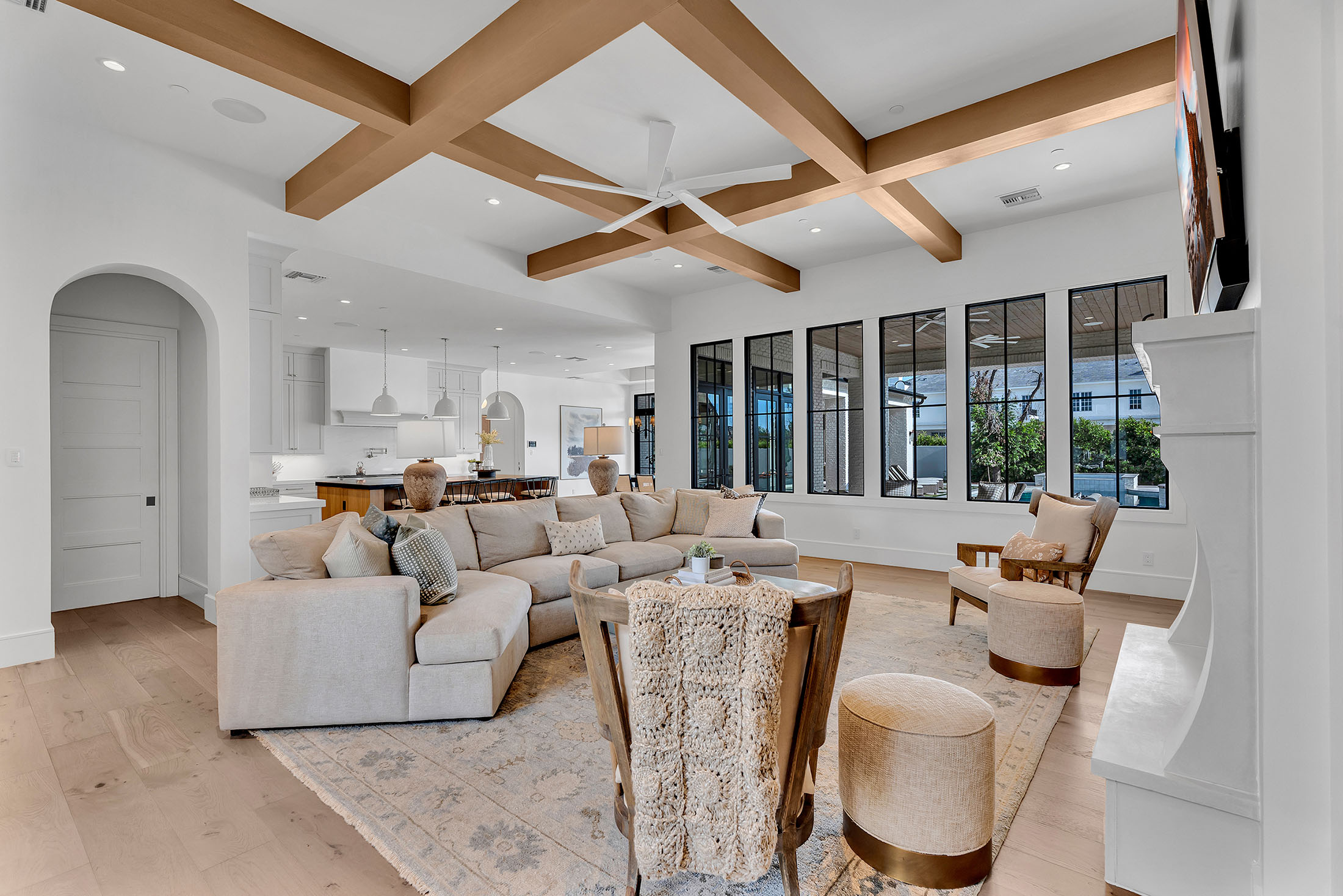
Start with textiles. A quality area rug grounds the seating arrangement and defines the living area within a larger open-plan space. Throw pillows add color and softness. A draped throw on the sofa arm signals warmth and comfort. These aren’t afterthoughts — they’re essential layers that make a room feel livable and complete.
Art gives the room personality. A single large-scale piece above the sofa or fireplace makes a stronger statement than a scattered collection of small frames. Choose something that moves you, not something that “matches the palette.” The palette should support the art, not the other way around.
Finally, add the objects that tell your story: a collected ceramic, a stack of books you’ve actually read, a candle with a scent that reminds you of something specific, a sculptural object that catches your eye every time you walk past. These are the details that make guests say “I love your home” instead of “I love your furniture.” For curated decor that elevates these finishing touches, Designly Done’s online shop carries a hand-selected collection of accessories, art, and decorative objects chosen by Ashley Kuhni with exactly this purpose in mind.
The Difference a Design-Build Approach Makes
When you build a custom home with The Ashtin Group, the living room isn’t an afterthought — it’s designed from the foundation up to be the heart of the home. Justin Kuhni builds the structure with precision and craftsmanship. Ashley Kuhni designs the interior with the furnishing plan already in mind. That means the architecture, the lighting plan, the outlet placement, the window proportions, and the material palette are all coordinated before a single piece of furniture enters the room.
This integrated design-build approach eliminates the most common frustrations of living room furnishing: outlets in the wrong place, windows that compete with where you need to put the sofa, ceilings that feel too low for the furniture scale you wanted, or a fireplace that’s off-center and throws the whole layout off. When the builder and the designer are working together from day one — as they do at The Ashtin Group — those problems simply don’t exist.
Even if you’re not building a custom home, you can borrow this mindset: think about the room as a complete system, not a collection of individual purchases. Every element should support every other element. That’s how to furnish a living room that looks intentional, feels comfortable, and stands the test of time.
Frequently Asked Questions
What is the best way to start furnishing a living room? Start by studying the room itself — its dimensions, natural light, focal points, and traffic flow. Then define how you’ll actually use the space before selecting any furniture. This approach ensures every piece serves both the room and your lifestyle, which is the foundation of any successful living room design.
How do I choose the right size sofa for my living room? Measure your room and create a scaled floor plan before shopping. The sofa should be proportional to the space — large enough to anchor the seating area but not so large that it overwhelms the room or blocks walkways. Leave at least 30–36 inches for traffic paths around the furniture.
Should living room furniture match? No — matching furniture sets tend to look generic. Instead, choose pieces that share a similar level of quality and formality but differ in shape, material, or texture. This creates a collected, intentional look. For help curating complementary pieces, the design team at Designly Done specializes in this kind of styling.
What are the most important pieces of furniture for a living room? The anchor pieces — a sofa, one or two accent chairs, and a coffee table — define the room. From there, add side tables, lighting (floor and table lamps), an area rug, and decorative objects. Lighting is often the most underestimated element; layered lighting transforms how a room feels.
How does building a custom home help with living room design? When you build with The Ashtin Group, the living room architecture is designed with furnishing in mind from the start — ceiling height, outlet placement, window proportions, and material palette all coordinated before construction begins. This eliminates common frustrations and creates a space that’s ready to furnish beautifully from day one.
Where can I find quality living room decor and accessories in Utah? Designly Done is a designer-curated home decor store and design center in Provo, Utah, founded by Ashley Kuhni. Their collection includes lighting, textiles, art, and decorative objects hand-selected to work in elevated interiors. Shop online at designlydone.com or visit in person.
Ready to Build the Home Your Living Room Deserves?
Whether you’re furnishing an existing space or dreaming of a home designed around the way you actually live, The Ashtin Group and Designly Done bring the expertise to make it extraordinary.
Ashtin Group UT — Utah County’s Luxury Custom Home Builder | ashtingrouput.com Designly Done — Utah County’s Luxury Home Decor Store & Design Center | designlydone.com
Building and designing extraordinary homes across Provo, Orem, Lehi, Saratoga Springs, Eagle Mountain, Springville, Spanish Fork, Mapleton, Payson, and all of Utah County, Utah.
About the Founders: Ashley and Justin Kuhni are the founders of Designly Done (luxury home decor store and full-service interior design center) and Ashtin Group UT (luxury custom home builder serving the Wasatch Front). Together they lead an integrated design-build team dedicated to creating and furnishing extraordinary homes throughout Utah County. Learn more at ashtingrouput.com.